
By Team BiharConnect
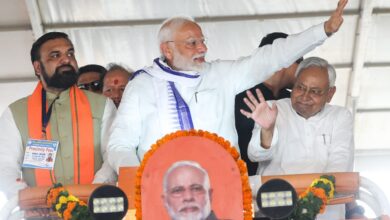
Prime Minister Narendra Modi on Monday laid the foundation stone for nine National Highway projects worth Rs.14,000 crore in Bihar. This involves road length of about 350 kilometers. The highway projects include construction of 3 large bridges, upgrading of highways into 4 lanes and 6 lanes.
The projects include four-laning of 47.23 km Bakhtiyarpur-Rajauli section of NH-31 at a cost of Rs 1149.55 crore, four-laning of 50.89 km Bakhtiyarpur-Rajauli section of NH-31 at a cost of Rs 2650.76 crore, four-laning of 54.53 km Ara-Mohania section of NH-30 on EPC Mode at a cost of Rs 885.41 crore, four-laning of 60.80 km Ara-Mohania section of NH-30 on EPC Mode at a cost of Rs 855.93 crore, four-laning of 49 km Narenpur-Purnea Section of NH-131A on HAM Mode at a cost of Rs 2288 crore, six-laning of 39 km Patna-Ring Road (Kanhauli-Ramnagar) of NH 131G on EPC Mode at a cost of Rs 913.15 crore.
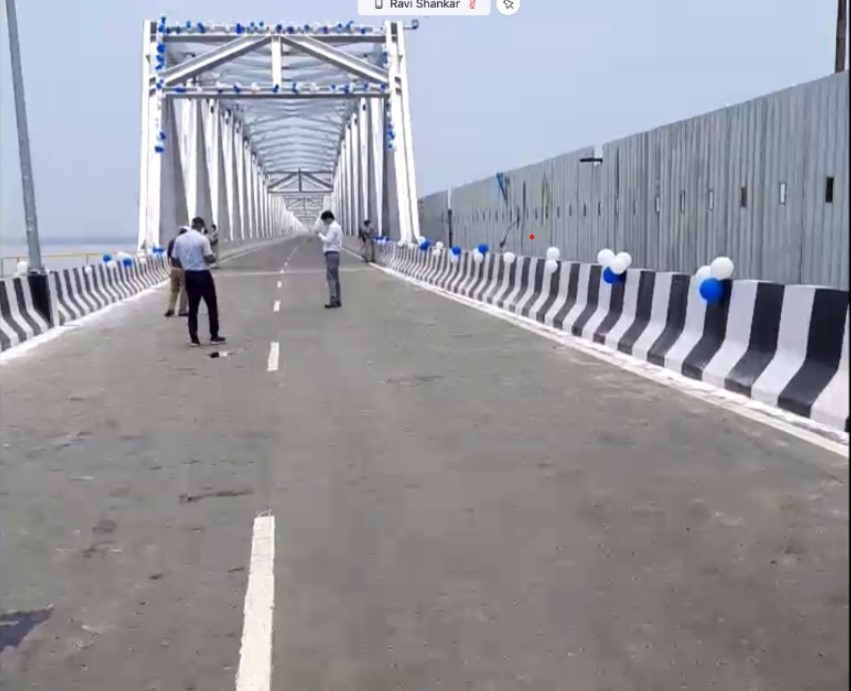
It also involves construction of a new 14.5 km four-lane bridge (Parallel to existing MG Setu) with its approaches across river Ganga on NH-19 at Patna at a cost of Rs 2926.42 crore, construction of a new 28.93 km 4-lane bridge across river Kosi on NH-106 with 2-Lane paved shoulder on EPC mode at a cost of Rs 1478.40 crore, and construction of new 4.445 km 4-Lane bridge (parallel to existing Vikramashila Setu) across river Ganga on NH-131B at a cost of Rs 1110.23 crore.
The prime minister laid the foundation of these projects through a virtual event. Speaking on the occasion, Modi said these highway projects would improve the connectivity in Bihar.
On construction of bridges, Modi said all rivers in Bihar will have bridges confirming to 21st century specifications and all major NHs will stand widened and strengthened.
Prime Minister said that the approach now is to develop a Multi-Modal Transport Network where each mode of transport is linked to the other. The scale at which work is now being done on infrastructure related projects, the speed at which work is being done is unprecedented. “Today, highways are being built at twice the speed than before 2014. Compared to the period before 2014 there has been a 5 times increase in the expenditure of highway construction,” he said.
Modi said the Government has announced to spend more than Rs 110 lakh crore on infrastructure in the coming 4-5 years. Out of this, projects worth more than Rs 19 lakh crore are allocated for the development of Highways alone.
Prime Minister said Bihar is also benefiting from these efforts to expand the infrastructure related to road and connectivity. Under the Prime Ministers Package announced in 2015, over 3000 Kms of National Highway were proposed. In addition, under the Bharatmala Project, a six and a half kilometer national highway is being constructed. Today in Bihar, the work on the national highway grid is going at a fast pace. There are 5 projects underway to connect East and West Bihar with four lanes and 6 projects underway to connect North India with South India.
He said, the biggest obstacle in Bihar’s connectivity has been due to large rivers. This is the reason that special attention was paid to the construction of bridges when the PM package was announced. Under PM package 17 bridges are being built over Ganges and most of which have been completed. Similarly, bridges are being constructed on the Gandak and Kosi rivers.
Prime Minister said the Patna ring road and the bridge parallel to Mahatma Gandhi Setu and Vikramshila setu in Patna and Bhagalpur will speed up the connectivity.