Samrat Choudhary sworn in as Bihar’s 24th chief minister
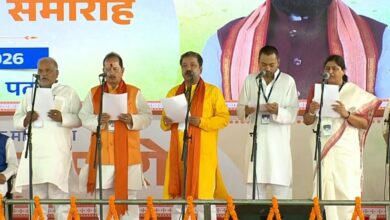
Governor Syed Ata Hasnain administered the oath of office and secrecy at a ceremony held at Lok Bhawan, where JD(U) leaders Vijay Kumar Choudhary and Bijendra Prasad Yadav were also sworn in as members of the Council of Ministers.


Samrat Choudhary on April 15 took oath as Bihar’s 24th Chief Minister, becoming the first leader from the Bharatiya Janata Party to occupy the top post in the state.
Governor Syed Ata Hasnain administered the oath of office and secrecy at a ceremony held at Lok Bhawan, where JD(U) leaders Vijay Kumar Choudhary and Bijendra Prasad Yadav were also sworn in as members of the Council of Ministers.
His swearing-in follows his election as leader of the BJP legislature party after the resignation of Nitish Kumar, in what marks a decisive transfer of power and a reset in Bihar’s political hierarchy.
Choudhary’s elevation caps a steady political rise—from Deputy Chief Minister earlier this year, where he handled key portfolios including Home, to now leading the state government—placing him at the centre of a major political realignment with the BJP assuming a leadership role for the first time.
The ceremony was attended by top NDA leaders, including Union ministers J. P. Nadda and Chirag Paswan, along with Nitish Kumar and NDA MLAs.
Shortly after his swearing-in ceremony, Choudhary took charge of the top chair at the Bihar Secretariat.
Earlier on Tuesday, Choudhary assured that the BJP will continue to prioritise India before everything else. In a post on X, he expressed gratitude to the party and called the role a “sacred opportunity” to serve the people of Bihar.
“I express my heartfelt gratitude to the central leadership of the Bharatiya Janata Party for reposing their trust in me… This is not merely a position for me, but a sacred opportunity to serve the people of Bihar,” he added.
‘Product of Lalu Yadav’s classroom’
Leader of Opposition in the Bihar assembly and RJD leader Tejashwi Yadav on Tuesday said that the newly sworn-in chief minister of Bihar, Samrat Choudhary, is a “product of Lalu Yadav’s classroom”.
The RJD leader said that Samrat Choudhary was not chosen as Bihar’s CM by the people, alleging that the Bharatiya Janata Party (BJP) ended the tenure of Nitish Kumar, who resigned from the CM chair on Tuesday.
“Samrat Choudhary is a product of Lalu Yadav’s classroom. Bihar’s politics will continue to revolve around Lalu Yadav… The BJP, too, governed alongside them (NDA) for 20 years. Yet, Bihar’s treasury remains empty,” he told reporters.
“This is not a Chief Minister chosen by the people of Bihar. The mandate was not given by the public… ‘Nitish ji ko BJP ne khatam kar diya toh vo ab khatam ho gaye hai (The BJP has finished Nitish, so he is over now),” he was quoted as saying by news agency ANI.
Rise in BJP
Born on November 16, 1968, in Lakhanpur village in Munger district, Choudhary comes from a politically active family. His father, Shakuni Choudhary, was a six-time MLA and Member of Parliament, while his mother, Parvati Devi, represented the Tarapur constituency.
He completed his early education in his hometown before pursuing higher studies at Madurai Kamaraj University, and began his political journey in 1990. In 1999, he served as Bihar’s Agriculture Minister during the Rabri Devi-led government.
Choudhary has been elected twice as an MLA from Parbatta (2000 and 2010), and also served as chief whip of the opposition in the Assembly. He later held the Urban Development and Housing portfolio from 2014.
His rise within the BJP accelerated after he joined the party, culminating in his appointment as Bihar BJP president in March 2023, succeeding Sanjay Jaiswal. The move was part of the party’s broader strategy to strengthen its outreach among OBC communities, particularly the Kushwaha/Koeri group, where Choudhary is seen as a key face.
In January 2024, he became leader of the BJP legislature party and was sworn in as Deputy Chief Minister, handling key portfolios including Finance, Health, Urban Development, and Panchayati Raj. His tenure saw a focus on administrative reforms, improvements in policing and traffic management, and efforts to boost transparency and investment through streamlined CSR initiatives.
Known for his combative political style, Choudhary has frequently taken an aggressive stance against rivals. His symbolic decision to wear a turban during the BJP’s split with JD(U)—pledging to remove it only after the party returned to power—reinforced his image as a determined political figure.
Nitish Kumar’s exit
Choudhary’s swearing-in follows the resignation of Nitish Kumar, bringing to a close yet another phase in the veteran leader’s long and influential political journey in Bihar. His exit not only ended the immediate tenure but also redrew the state’s political equations, paving the way for a clear shift in leadership dynamics.
For years, the BJP had operated as a junior partner in Bihar’s political structure, backing Nitish Kumar-led governments across shifting alliances. Choudhary’s elevation marks a decisive break from that pattern, with the party now assuming direct control of the Chief Minister’s office for the first time.
The transition is a broader recalibration within the state’s political landscape: one where leadership, social outreach strategies, and governance priorities are expected to align more closely with the BJP’s organisational vision.