Saffron wave: Party founded by a Bengali finally sweeps West Bengal
The scale of the BJP's rise in Bengal is staggering when viewed against the historical arc. The party held zero seats in the state in both 2006 and 2011, the very elections that swept Mamata Banerjee to power on the back of anti-Left sentiment. By 2016, the BJP had scraped together just three seats.
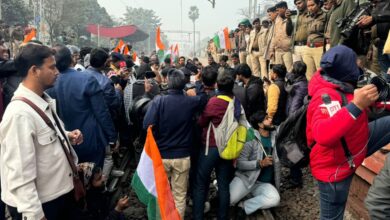
The streets of West Bengal turned saffron on Monday as Bharatiya Janata Party workers poured out in celebration, distributing laddoos and raising slogans, marking what appears to be the end of Mamata Banerjee’s 15-year grip on the state.
With the BJP leading in 194 seats out of 294 in the assembly elections, the ruling All India Trinamool Congress was reduced to 94 constituencies, a dramatic collapse for a party that had swept 216 seats as recently as 2021. The numbers tell a story of a swift and sweeping reversal.
The scale of the BJP’s rise in Bengal is staggering when viewed against the historical arc. The party held zero seats in the state in both 2006 and 2011, the very elections that swept Mamata Banerjee to power on the back of anti-Left sentiment. By 2016, the BJP had scraped together just three seats.
The 2021 elections marked the first real saffron surge, with the party winning 77 seats, significant, but still well short of power.
In 2026, that number has vaulted to 194, crossing the majority mark of 148 in a 294-seat house.
BJP’s historical link to West Bengal
To understand the significance of this moment, one has to return to Shyama Prasad Mookerjee, not just as a founder, but as a distinctly Bengali political figure shaped by the turbulence of the 1930s and 1940s. Born into an eminent Kolkata family, Mookerjee rose quickly in public life, becoming one of the youngest vice-chancellors of the University of Calcutta and later entering provincial politics. He served as Finance Minister of Bengal under a coalition government in the early 1940s, a period marked by intense communal and political conflicts.
Mookerjee’s politics in Bengal were shaped by two parallel concerns of the protection of Hindu interests in a communally polarised province and a strong belief in national unity. He opposed the partition of Bengal in its entirety, instead advocating the division of the province to ensure that Hindu-majority areas remained within India. This positioned him as a key player in the politics of Bengal, even as it also limited his appeal across communities.
After Independence, Mookerjee joined Jawaharlal Nehru’s cabinet as Industry Minister but resigned in 1950 over differences related to the Nehru-Liaquat Pact and broader questions of minority policy and national integration. His departure marked the beginning of an alternative political project. In 1951, he founded the Bharatiya Jana Sangh, seeking to create a disciplined, ideologically coherent opposition rooted in cultural nationalism.

From Jana Sangh to BJP
The Jana Sangh’s early performance was nothing impressive. In the 1952 general elections, it won just three Lok Sabha seats nationwide, but notably two of them from West Bengal. However, that outcome was less a sign of organisational strength than of Mookerjee’s personal stature and networks in the state. After his death in 1953, the party’s Bengal base eroded quickly. Without a comparable leadership or wide mass base, the Jana Sangh struggled to compete in a state where politics was increasingly defined by class mobilisation and Left ideology.
Over the next decades, West Bengal moved in a very different direction from the one Mookerjee had envisaged. The rise of the Left Front, led by the Communist Party of India (Marxist), created a political ecosystem centred on land reforms, trade unionism and rural mobilisation. This was not fertile ground for the Jana Sangh or, later, the BJP. Even when the Jana Sangh reconstituted itself as the BJP in 1980 after the Janata Party phase, Bengal remained peripheral to its strategy.
The BJP’s ideological appeal struggled in Bengal not simply because of organisational weakness, but because the state’s political culture prioritised class over religious identity for much of the post-independence period. The BJP’s growth model, which worked in parts of north and west India, did not translate easily into Bengal’s context.
This began to change only gradually. The decline of the Left after 2009 and the rise of Mamata Banerjee opened up a new political space. Yet even in the early 2010s, the BJP remained a marginal force. Its vote share was limited and its cadre base thin.
BJP’s electoral evolution in West Bengal
Under Mookerjee, the Jan Sangha won two seats with 5.59% vote share in its debut in the 1952 Lok Sabha polls. It also contested in assembly elections and won 9 seats by securing a 5.58% vote share under the leadership of Mookerjee.
The electoral trajectory of the Jana Sangh (BJS) and later the Bharatiya Janata Party (BJP) in West Bengal reflects a shift from marginal presence to gradual consolidation. In the 1950s and 1960s, the Jana Sangh remained electorally weak despite support among Hindu refugees. Its vote share stayed minimal, and it failed to win significant seats, indicating poor organisational depth in a state dominated first by the Congress and later by Left forces.
A breakthrough came in 1977 when the Jana Sangh merged into the Janata Party following the Emergency. In the 1977 West Bengal Assembly elections, the Janata Party won 29 seats, marking the first substantial success of the Jana Sangh. However, this success was short-lived. After the Janata Party split in 1980 and the BJP was formed, the party again declined sharply. In the 1982 and 1987 Assembly elections, the BJP won 0 seats, with vote shares of around 1-2%, reflecting organisational weakness and leadership gaps after the deaths of early leaders.
The situation began to change in the early 1990s. Riding on national-level mobilization such as the Ram Janmabhoomi movement, the BJP increased its vote share significantly. In the 1991 elections, it secured more than 10% vote share in both Assembly and Lok Sabha polls, though it still failed to win seats. This marked its emergence as a minor but noticeable political force.
A major turning point came with its alliance with Mamata Banerjee’s Trinamool, formed in 1997. In the 1998 Lok Sabha elections, the BJP won 1 seat in West Bengal, which increased to 2 seats in 1999, with vote shares rising to around 10-11%. The alliance continued into the 2001 Assembly elections, where the BJP contested as a junior partner but still failed to win seats, maintaining a vote share of roughly 5%.
After the alliance weakened in the mid-2000s, the BJP’s performance dipped again. In the 2006 Assembly elections, it won 0 seats with about 2% vote share, and in the 2009 Lok Sabha elections, it again failed to win seats, polling around 6% votes. Despite this decline, the earlier alliance phase had expanded its organisational base and visibility.
BJP’s focus in North East
The BJP’s victory in the 2014 general elections marked a turning point in its eastern ambitions. With power at the Centre, the party began systematically expanding into regions where it had historically been weak. The northeast became an early success story, with gains in Assam and Tripura demonstrating that entrenched political systems could be overturned.
West Bengal was a more complex challenge. Unlike smaller northeastern states, it had a dense political culture, strong regional identity and a powerful incumbent in Mamata Banerjee. The BJP’s approach combined several elements: building a grassroots organisation, inducting leaders from rival parties, deploying central leadership extensively and reframing political discourse around identity, governance and welfare delivery.
There was a sharp rise in the BJP’s vote share in Bengal, particularly in the 2019 Lok Sabha elections where it emerged as the principal challenger to the Trinamool Congress. That election was a signal that the party had moved beyond symbolic presence to real competitiveness. Over the past decade, the BJP has also worked to localise its narrative. While its core ideology remains national, its Bengal strategy has increasingly invoked regional icons, local grievances and welfare comparisons. This dual strategy, combining national leadership with local adaptation, has been central to its attempt to break through in the state.